Dying Without a Will
in Texas:
Who Inherits the Property?
When someone dies without a valid will, Texas law decides
who inherits the house. Learn how intestate succession works,
what a life estate means, and what your options are before
selling an inherited property.

Inherited a House in Texas?
If the owner died without a will, you may still be able to sell the property. USA Buying Team buys inherited as-is and can work with a title company to identify what must be cleared before closing.
If you’re considering selling instead of keeping the property, learn how to sell an inherited house in Texas.
What Does "Dying Without a Will" Mean?
A person who dies without a valid will is said to have died intestate.
When that happens, the deceased person’s property is distributed according to Texas intestate succession law rather than according to what family members believe the deceased person wanted.
Texas intestate succession is governed by the Texas Estates Code, which sets out how property passes when someone dies without a valid will.
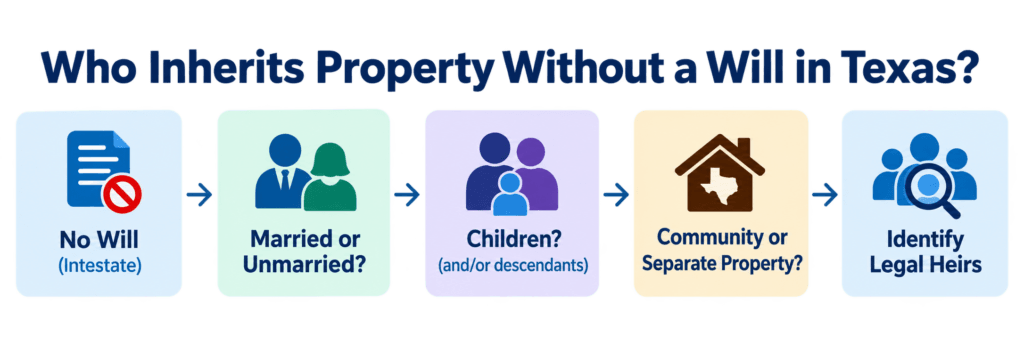
Important questions Texas law considers include:
- Was the deceased person married?
- Did the deceased person have children?
- Were all of the children also children of the surviving spouse?
- Was the house community property or separate property?
- Did any child die before the property owner?
- Are there grandchildren?
- If there are no children, are the deceased person’s parents or siblings still living?
If the Deceased Person Was Not Married
If an unmarried person dies without a will:
- With children or descendants: The children generally inherit equally. Grandchildren may inherit their deceased parent’s share.
- With no children: Property may pass to parents, siblings, nieces, nephews, or more distant relatives.
If the Deceased Person Was Married
It depends on whether the property was community property or separate property—and whether the children are also the children of the surviving spouse.
These factors can dramatically change who inherits.
Children From Another Relationship
If the deceased had a child from a previous relationship, that child (or their descendants) may inherit part of the deceased spouse’s interest—even if a surviving spouse is living.
This is one of the most common situations that leads to multiple heirs.
Affidavit of Heirship
An Affidavit of Heirship is commonly used in Texas to document a deceased person’s family and marital history when real estate is involved. It may identify the surviving spouse, children, descendants, parents, siblings, and other potential heirs.
What if Heirs Don't Agree?
One heir may want to keep the property while another wants to sell. Other heirs may live out of state, be difficult to locate, or may have died themselves.
The first step is determining who actually owns an interest in the property. From there, a title company or Texas attorney can determine what signatures or legal steps may be necessary.
Practical Steps
- ✓
Get the most recent deed. - ✓
Determine if the property is community or separate. - ✓
Build the family tree (spouse, children, grandchildren, parents, siblings). - ✓
Gather death, marriage and divorce records. - ✓
Have the title reviewed by a title company. - ✓
Determine if probate or heirship documentation is needed. - ✓
Decide whether to keep or sell the property.
USA Buying Team Can Help
We buy inherited houses in Texas, even if there are title issues or family complications.
We’ll review the property, work with a title company, and make a no-obligation cash offer.
As-Is Purchases
No Repairs Needed
Close on Your Timeline
Frequently Asked Questions About Dying Without a Will in Texas
What does “dying without a will” mean in Texas?
A person who dies without a valid will is said to have died intestate. When that happens, Texas intestate succession law determines how the deceased person’s property is distributed rather than the deceased person directing the distribution through a valid will.
What happens to a house when someone dies without a will in Texas?
The house does not automatically become the property of whoever lived there or was closest to the deceased person. The deceased person’s ownership interest passes according to Texas inheritance law, and several people may end up owning interests in the same property.
Does a surviving spouse automatically inherit the entire house in Texas?
No. The answer depends on whether the property was community property or separate property, whether the deceased person had children or other descendants, and whether those descendants were also descendants of the surviving spouse.
Who inherits if the deceased person was unmarried and had children?
If an unmarried person dies without a will and leaves children or other descendants, the children generally inherit the estate. If a child died earlier but left children of their own, those grandchildren may inherit their deceased parent’s share.
Who inherits if the deceased person was unmarried and had no children?
Texas law generally moves up and across the family tree. Depending on who survives, property may pass to parents, brothers and sisters, nieces and nephews, or more distant relatives.
What is the difference between community property and separate property?
Community property generally includes property acquired during a marriage, subject to important exceptions. Separate property can include property owned before marriage or property received during marriage by gift or inheritance. The classification can dramatically affect who inherits the property.
What happens if a married person dies and all the children are also children of the surviving spouse?
For community property, if all of the deceased spouse’s surviving children or descendants are also descendants of the surviving spouse, the deceased spouse’s community-property interest generally passes to the surviving spouse. Separate property is treated differently.
What happens if the deceased person had children from another relationship?
If at least one surviving child or descendant of the deceased spouse is not also a child or descendant of the surviving spouse, the deceased spouse’s share of community property may pass to the deceased spouse’s children or descendants while the surviving spouse keeps his or her own community-property interest.
What happens if one of the deceased person’s children is already dead?
That child’s descendants may inherit the share their parent would have received. This can cause ownership to pass through multiple generations and result in several people having interests in the same house.
Can grandchildren inherit property when someone dies without a will?
Yes. Grandchildren may inherit through a deceased parent’s family line when that parent would otherwise have inherited from the deceased property owner.
What is a life estate in Texas?
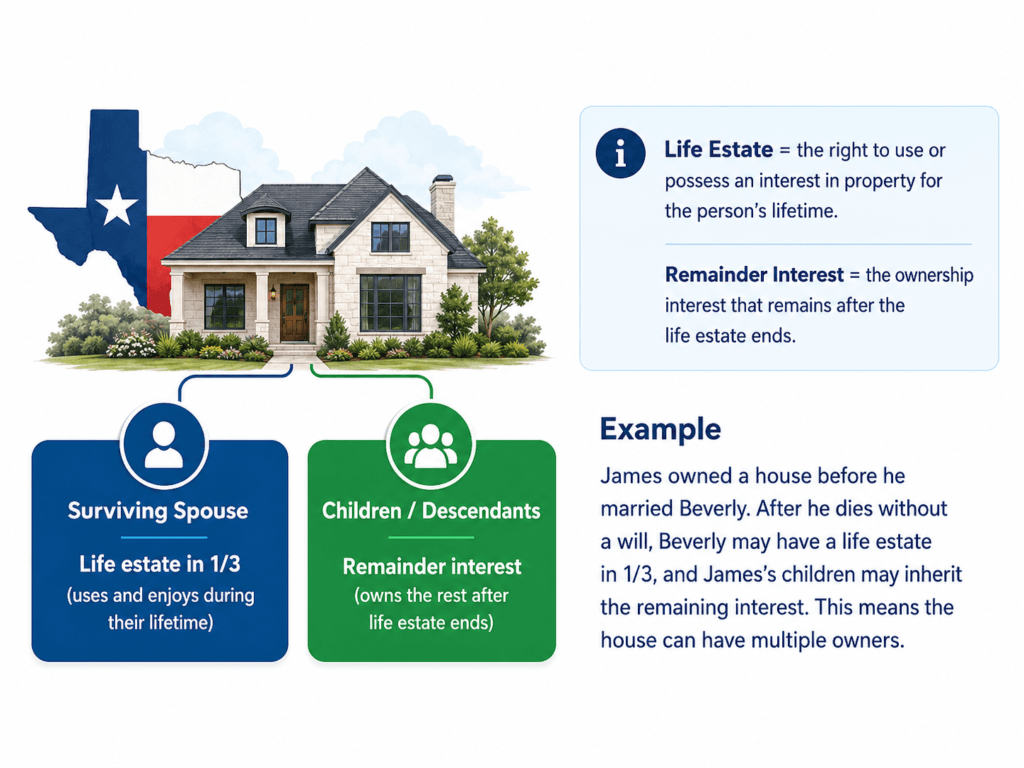
A life estate gives someone the right to possess, use, or benefit from an interest in property during that person’s lifetime. Another person may own what is called the remainder interest, which continues after the life estate ends.
What is the Texas intestate life-estate rule?
When a married person dies without a will leaving a spouse and one or more children or descendants, Texas law generally gives the surviving spouse one-third of the deceased spouse’s separate personal property and a life estate in one-third of the deceased spouse’s separate land. The children or descendants hold the remainder interest in that portion.
Does a one-third life estate mean the surviving spouse owns one-third of the house physically?
No. It does not mean one bedroom, one-third of the square footage, or a particular physical section of the house. A life estate is a legal ownership interest.
Can someone with a life estate sell the entire house?
Generally, the life tenant cannot convey someone else’s remainder interest simply by signing a deed alone. A title company may require signatures or legal authority covering both the life-estate interest and the remainder interests before complete title can be transferred.
How do you prove who the legal heirs are?
Depending on the circumstances, the family may need death certificates, marriage or divorce records, birth records, probate documents, a court determination of heirship, affidavits from people familiar with the family history, an Affidavit of Heirship, deeds from heirs, or other documents required by the title company.
What is an Affidavit of Heirship in Texas?
An Affidavit of Heirship is commonly used to document a deceased person’s family and marital history when real estate is involved. It may identify spouses, children, descendants, parents, siblings, and other potential heirs.
Can an Affidavit of Heirship be used instead of probate?
Sometimes, but not in every situation. An Affidavit of Heirship does not automatically fix every title problem, and title companies may have additional requirements. Some situations may require probate or a court determination of heirship.
What happens if the heirs cannot agree about selling the house?
One heir may want to keep the property while another wants to sell. Other heirs may live out of state, be difficult to locate, or may have died themselves. The first step is determining who actually owns what. A title company or attorney can then determine what signatures or legal authority may be required.
Does every heir have to sign to sell an inherited house?
Not necessarily. Sometimes the heirs themselves convey their interests. In other situations, an executor, administrator, probate order, or other legal authority may allow someone to act for the estate. The important question is who the title company requires to sign or have authority to deliver clear title.
Can USA Buying Team buy an inherited house with title or heirship problems?
Possibly. USA Buying Team buys inherited houses in Texas, including properties that may need repairs or have title or heirship matters that must be addressed before closing. We can review the property, make a no-obligation cash offer, and work with a title company to determine what must happen before closing. You do not necessarily need to repair, remodel, or clean out the property before contacting us.
Have an Inherited House You Need to Sell?
You don’t have to figure everything out before calling us. Tell us what you know about the property and family situation, and we’ll see whether a cash sale is an option.
No repairs. No agent commissions. No obligation.